
Tenderiva · TED
Public procurement data: what a TED notice can really tell you
A notice count can illuminate publication activity. It cannot, on its own, measure contracts, money spent or time available to businesses. This guide uses the Tenderiva edition covering Aug 31, 2026 – Sep 29, 2026 to explain how to interpret those indicators.
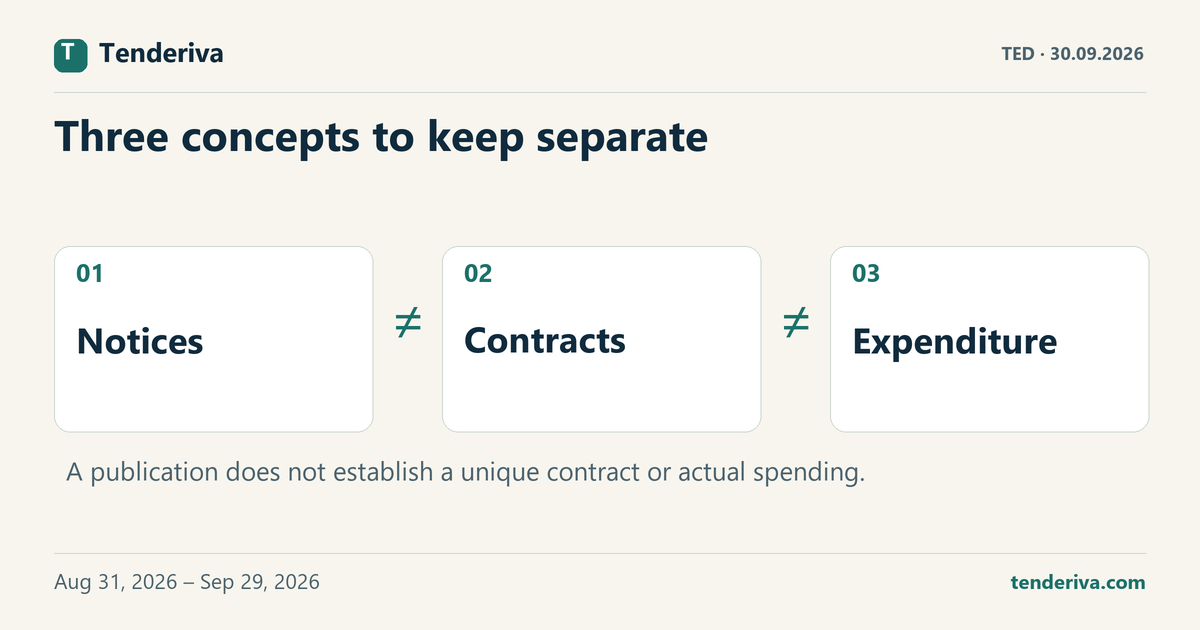
A notice is not a contract
One procedure may generate several publications and contain multiple lots. A notice may announce a requirement, amend information or report a later stage. Its type and connection to the procedure must be checked before counting contracts.
The 61,033 units in this edition are TED notices within Tenderiva’s selected scope. They are not every public procurement opportunity in Europe, including those published only on national portals.
An unusable value is not evidence of secrecy
Our extraction retains a usable value for 28,008 notices, or 45.9% of the corpus. The remaining 54.1% have no value retained for this calculation. That describes our indicator, rather than a transparency ranking of buyers.
Information may be missing, require a document review or appear in a form that is not comparable. An estimated value is not money actually spent either. Currencies and scope must be reconciled before amounts are added together.
The publication-to-deadline gap may not be the initial response window
The calculation uses 31,672 notices, or 51.9% of the corpus, with an eligible gap. Their median is 30 calendar days. An amendment may be published after the initial notice, however, and application and tender submission phases are not separated.
Describing that median as the time given to every business would therefore be misleading. Assessing a specific procurement requires the dates and amendments in its official procedure.
Keep a figure’s meaning when you cite it
State the unit, period, TED scope and sample size. Retain the edition link so that readers can find the same evidence after the barometer is updated.
Comparisons across periods also require sufficiently comparable collection. Until that is established, a dated snapshot is still useful; it simply must not be presented as a trend.
Sources and data behind this analysis
Aug 31, 2026 – Sep 29, 2026 · TED ↗ · Tenderiva
Cite this analysis
Tenderiva, analysis of observed TED notices, Sep 30, 2026. Data period: Aug 31, 2026 – Sep 29, 2026. https://tenderiva.com/barometer/reading-procurement-data